
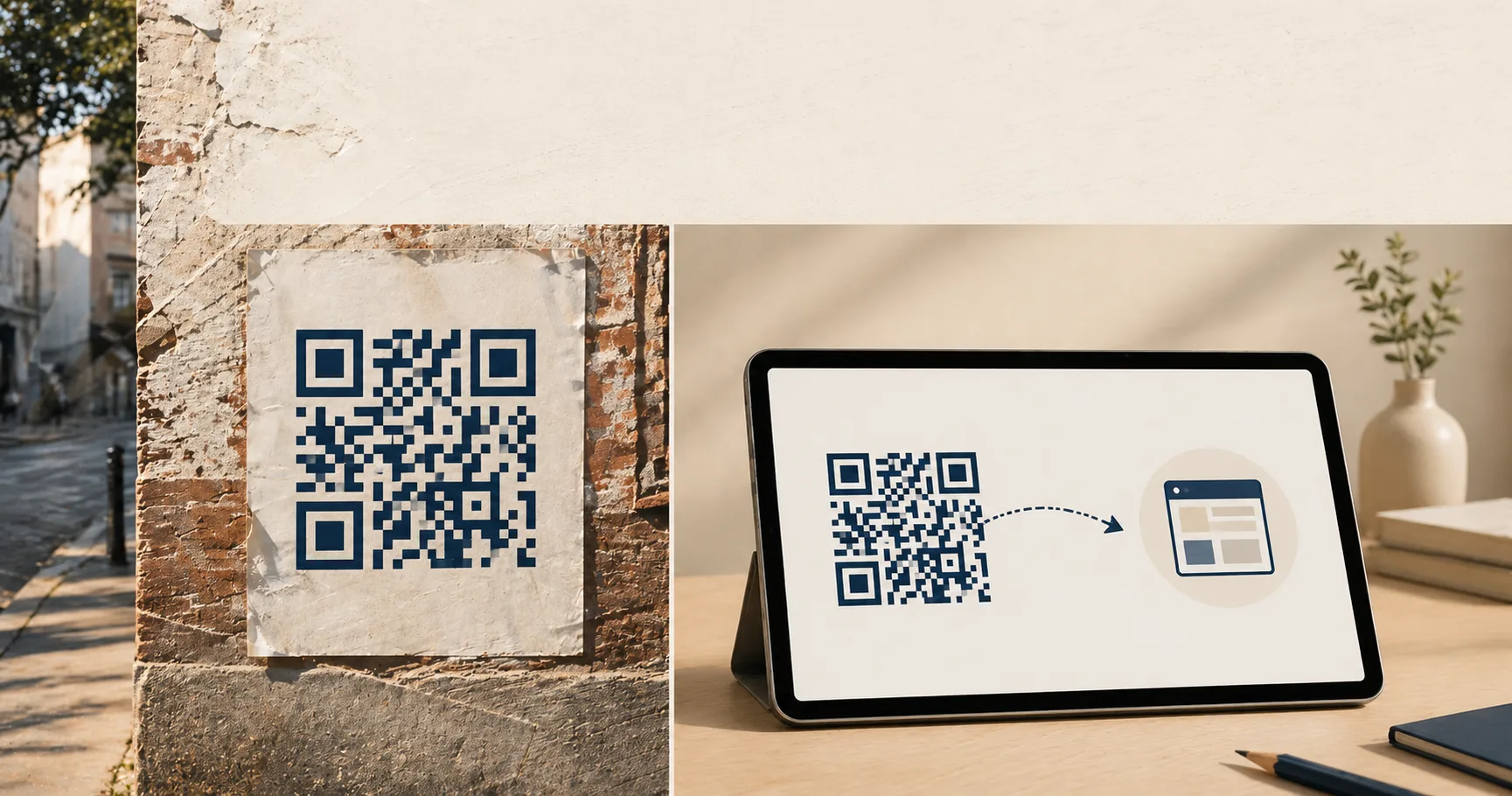
Choosing between static and dynamic QR codesA QR codeA 2D matrix barcode that encodes data in a square grid of black and white modulesA single black or white square in the QR grid. The number of modules per side scales with the QR versionThe size of a QR code, numbered 1 (21×21 modules) through 40 (177×177). Higher versions store more data but require more printed space. Read more →, from 21×21 modules for version 1 up to 177×177 for version 40. Read more →. Read more → that points to a short redirect URL controlled by a service. Read more → is less about features than about a single question: what’s likely to change after launch? If the destination is stable, static is simpler, cheaper, and more reliable. If the destination has to be editable after print, you need a dynamic workflow, and you accept the platform dependency that comes with it.
This post covers when each approach fits, the real trade-offs, and how to add tracking without a paid platform.
Key takeaways
- A static QR encodes the destination URL directly into the pattern; once printed, the URL can never change.
- A dynamic QR encodes a redirect URL on a vendor (or self-hosted) platform; you can repoint the destination, route by device or geo, and capture scan analytics anytime.
- Static is right for stable, long-life surfaces — packaging, business cards, Wi-Fi signs — where simplicity beats flexibility.
- Dynamic is right for rotating campaigns, A/B tests, and any placement where the destination is likely to change before the print run is retired.
- Static codes can still be tracked via UTM parameters or unique paths per placement — losing dynamic doesn’t mean losing attribution.
How static QR codes actually work
A static QR codeA QR code where the destination is encoded directly inside the matrix. Once printed, the destination cannot be changed. Read more → stores the destination URL inside the code itself. The pattern of black and white modules is a direct encoding of https://example.com/menu (or whatever you generated). When someone scans the code, the phone reads the URL straight from the pattern and opens it.
This has one immediate consequence: if the destination URL changes, the code is permanently obsolete. There’s no central server to update. Whatever you printed continues to point at whatever you encoded, forever.
Static codes are usually best when:
- The destination is stable, like a permanent product page or a long-running landing page.
- You don’t need post-launch link editing.
- You want a privacy-first, account-free workflow with no third-party platform in the loop.
- You’re printing high volumes (packaging, signage, business cards) where a dependency on a redirect service would be a long-term liability.
How dynamic QR codes actually work
A dynamic QR code encodes a short redirect URL controlled by a third-party platform (or by you, if you run your own redirect service). When scanned, the phone opens the redirect URL, which then forwards to the real destination.
The encoded URL never changes. The platform’s redirect rule does. That means you can update the final destination, route by device or location, and capture scan analytics, all without reprinting anything.
Dynamic workflows make sense when:
- The destination is likely to change by season, offer, inventory, or campaign.
- You need scan analytics broken down by placement or creative.
- You want to A/B-test landing pages behind the same printed code.
- Your campaign has a known retirement date and you want to point the code at a graceful “this offer ended” page afterward.
Where static codes are strongest
Static codes are the right default for long-life assets where URL stability is expected and operational simplicity matters more than routing flexibility:
Product packaging that stays in circulation for months or years. The URL needs to outlive the print run, which usually means keeping the destination simple and durable.
Permanent wayfinding signs in offices, lobbies, hospitals, and public spaces. Once installed, they shouldn’t need touching for years.
Business cards and profile materials. A static QR pointing at your LinkedIn or personal site is fine; a dynamic code adds a paid dependency for no obvious gain.
Educational posters, manuals, and reference handouts where the destination is a stable resource page.
Wi-Fi credential codes for guest networks. The credentials change rarely, and when they do, you’re reprinting the sign anyway.
If your team can commit to durable destination URLs, static codes give you high reliability with low operational overhead. Static doesn’t mean “no analytics” or “no campaign tracking.” More on that below.
Where dynamic workflows earn their cost
Dynamic setups are justified when change velocity is high and the cost of being unable to update outweighs the platform fee. Common cases:
Retail promotions with rotating offers, where the same printed code on a shelf-talker needs to point at different campaigns each month.
Limited-time campaigns with a planned expiry, where you want the code to gracefully redirect to a follow-up page after the offer ends.
Multi-location events or franchises where the destination needs to vary by city or store, ideally without reprinting per location.
Campaigns with frequent A/B tests on landing pages, where the printed code stays constant while you iterate on what’s behind it.
In those cases, dynamic routing lets you redirect outdated campaigns without reprinting, route users by location or device, and evaluate scan performance by placement and creative variant. The trade-off is governance. Someone has to own link health, redirect rules, account billing, and platform continuity. If that ownership is unclear, the campaign is one expired credit card away from a quiet failure.
Cost, ownership, and platform risk
Dynamic QR platforms are powerful, but they almost always introduce a subscription fee and a long-term platform dependency. The fee is usually fine. The dependency is the real cost, and it’s worth thinking about explicitly.
Concrete failure modes:
- The subscription lapses (forgotten card, organizational change), and every printed code starts returning a “subscription expired” page.
- The platform changes pricing, terms, or features, and you have to migrate while live codes are in the wild.
- The platform shuts down or is acquired, and your code library has to move on a deadline.
- The platform’s analytics dashboard becomes the single source of truth, and pulling that data into your own systems requires manual export forever.
With static codes, ownership is much simpler: if the destination URL still works, the code still works. There’s no third party in the loop. That simplicity is worth a lot for assets you can’t easily reprint.
If you do go dynamic, treat the platform like any other vendor dependency: document who owns the account, when the renewal happens, and what the migration plan looks like if you ever leave.
Tracking with static codes (yes, really)
A common misconception is that static codes can’t be tracked. They can. You just have to put the tracking in the URL itself, which means deciding tracking before you generate the code.
Two approaches that work well:
UTM parameters on the destination URL. Encoding https://example.com/summer?utm_source=poster&utm_medium=qr&utm_campaign=summer-2026 gives you full attribution in Google Analytics or any analytics platform that respects UTMs. Keep the parameters short, because long URLs make denser codes that are harder to scan at small sizes.
Unique clean paths per placement. Encoding https://example.com/p/summer-poster-citymall lets you split traffic by placement using server-side analytics, without the visual noise of UTM parameters. This works especially well if you control the destination domain.
The size and print guidelines cover how URL length affects QR density and scan reliabilityHow consistently a QR code scans across different devices, lighting conditions, distances, and orientations. Read more →. If you need attribution, plan the URL structure first.
SEO and analytics implications
QR scans don’t directly affect search ranking, but the destination page does. A few things matter regardless of static vs dynamic:
- Topic continuity between the scan context and the destination. A QR on a restaurant menu should land on the menu, not the homepage.
- Mobile-first layout with strong load performance. QR scans are almost entirely mobile, and a slow page is wasted intent.
- Internal links to related guides and next actions on the destination, so a scan can turn into a deeper visit.
- Clean canonical URLs, so dynamic redirect chains don’t fragment your analytics.
The use-case playbooks walk through destination structure for common scenarios.
Decision checklist
Before you publish, run through these four questions:
- Will the destination change after print? If yes, dynamic helps. If no, static is simpler.
- Is per-placement scan analytics mandatory for reporting? Dynamic platforms make this trivial. Static can do it via UTMs or clean paths, but requires more upfront planning.
- Is reliability without platform lock-in more important than routing flexibility? Static avoids any third-party dependency.
- Can you commit to maintaining redirect infrastructure long-term? If no, static avoids that operational tax.
If three or four of those answers point one way, you have your answer. If they’re split, default to static and revisit later if the constraints change.
When static is the right call
Use static when the destination is stable for at least 6-12 months, team ownership is lightweight, and simplicity beats routing flexibility. Most small-business use cases fit here: a guest Wi-Fi sign, a restaurant menu, a business card, a packaging code pointing at a product page, a poster pointing at a long-running landing page.
When dynamic is worth the complexity
Use dynamic when campaigns change frequently after launch, attribution by placement is a hard reporting requirement, or operations can confidently maintain the redirect infrastructure, governance, and platform billing for the lifetime of the printed assets. Larger marketing teams running rotating retail or event campaigns are the strongest fit.
Default for small teams
Start with static QR codes for stable use cases. Move to dynamic only when you have a clear, recurring need for destination edits or campaign-level analytics that static workflows can’t satisfy. That keeps the workflow simple, removes platform risk, and preserves long-term reliability.
If you’re preparing print assets, pair this guide with the print-ready checklist before sending anything to press. If your next campaign is use-case specific, start from a focused playbook like retail packaging, event check-in, or payment links.
For the broader strategy view above this format choice, the 2026 QR code marketing guide and QR code analytics and tracking cover the campaign and measurement layers that determine whether the dynamic premium pays back. For deployment-specific takes, the retail QR strategies guide walks through where dynamic earns its keep on packaging at scale, and the restaurant QR menu playbook does the same for hospitality.
Sources
- Wikipedia — QR code — Background on QR code structure, payload encoding, and the static-by-default nature of the symbol.
- Denso Wave — QR Code variants — Reference for the static QR code family from the original inventor.
- ISO/IEC 18004:2015 — The international standard that defines the QR symbol; clarifies that redirect-based “dynamic” workflows are platform behaviour, not a different code type.
- GS1 — Digital Link — How standardized URI structures support stable, long-life destination URLs for static codes on packaging and product identifiers.


What we recommend for editable QR
Honest founder note — we're building our own Smart QR (editable destinations + scan analytics), but it's not ready yet. If you need dynamic today, t.ly is what I actually use while we build: branded short domains, redirect editing, and a clean analytics dashboard.